Showing posts with label Modern Literature. Show all posts

Tuesday, August 26, 2014

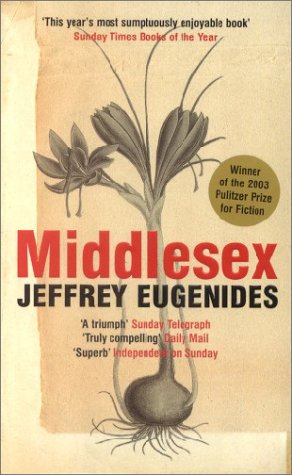
Middlesex ~ Jeffrey Eugenides

Not content with the emotional impact, nor the anatomical insight, contained in a diary written by an intersex convent girl in the 19th Century Jeffrey Eugenides decided to write a novel instead that would satisfy the reader's inquiring mind.

Middlesex is loosely based on the author's life and his own Greek heritage, however, Calliope/Cal (the protagonist) is his own creation and therefore the novel is not autobiographical.

I loved this book!!  Not only does it explore the themes of nature vs nurture, rebirth and the impact of a recessive gene on three generations of one family, but it also chronicles the life of two immigrant silkworm farmers from their isolated hillside home in Greece to their new life in prohibition era Detroit.

Calliope, their grand-daughter is born a hermaphrodite; however this is not discovered until she/he reaches puberty.  Told retrospectively, and commencing from the womb, Calliope takes us back to when her grandparents were young and how the recessive gene which is quite often found in isolated in-bred groups of people begins to rear its ugly head.

Really, this novel could have been distasteful however we are introduced to a wonderful group of characters with great personalities and eccentricities trying to make a success of their life in a new country, not knowing that their life choices are taking them down a road that will cause the teenage Calliope untold anguish.  Calliope suffers from the usual female teenage angst..... when will her period start?  Why is she so flat chested when her classmates are developing?  Why does she have a crush on her best friend?  Being of Greek heritage other tell tale signs are missed as she grows older .... the unwanted hair on her upper lip that needs waxing, the husky voice and the beginning of heavy set features.  I truly felt for Calliope as she brought back memories of my own insecurities as an introverted teenager.

One thing I didn't get was why Calliope's brother was called Chapter Eleven.  All the way through the novel I was hoping it would reveal itself.  It does actually, but very subtly and being Australian I didn't pick up on it.  American's would get it.  I won't spoil it here, read the book and if you are still in the dark you can Google Eugenides' answer.  It's quite clever.


Maxine

Thursday, October 6, 2011

Overblown and Under-Edited?

Who are we to criticize a novel for being overblown and under-edited?  Granted, some of the classics are awfully long, some due to the fact that they were serialised, but I guarantee that unless a novel is of a substantial size you won’t be drawn in or get to know the characters so well.

I find that a lot of modern novels are generally not long enough. and some of these ‘indie’ authors on Amazon seem to be writing what I would term as ‘pamphlets’.  There’s no substance to them at all.  Some are okay for a VERY light read to pass the time but mainly they are forgettable.

I read this blog post recently http://www.inpotentia.co.uk/2011/09/four-legs-good-two-legs-bad.html?m=1 and have been thinking about it a bit as I disagree with a couple of comments that were made.  Especially the remark about Sara Gruen’s Water for Elephants for example (I found this novel to be very entertaining and I like to think myself a discerning reader), and then there’s the dig at J K Rowling’s Harry Potter being woefully under-edited!  I’d like to see what my (adult) daughter and die-hard Potter fan would like to say to that.  I think they are wonderfully written novels, and very clever.  Their success and the fact that they have probably got more children (and adults) reading than any other series speaks for itself.  My son would never have picked up a book if not for Harry Potter.  I don’t think any real Potter fan would accept a novel of just a few hundred pages with no exposition or reference to the previous works.

I also read a review yesterday (on Good Reads) that criticized Anna Karenina for being under-edited.  You’ve got to be kidding!

So, give me an overblown under-edited novel any day, because I know that I’ll be thinking about the story and the characters long after I’ve tossed aside an indie ‘pamphlet’.

Actually, I totally digressed. as I really wanted to talk about Philip K Dick's Ubik.  I'll have to save that for another night!

Happy Reading!

Maxine

Saturday, August 20, 2011

This is How

This is just a quick post about my new read This is How by M J Hyland.  After really enjoying Carry Me Down, which I read a few months back, I thought I would try another of her books.  Carry Me Down was narrated by the protagonist and slowly unraveled to reveal his personality and emotional problems.  This is How is written in pretty much the same vein.  Patrick Oxtoby has moved into a boarding house by the sea after his engagement is broken off by his fiance.  We don't know why she broke off the engagement but I expect that this will be revealed later in the plot.  The clever use of the dialogue and Patrick's reactions to certain situations leads you to realise that despite his obvious intelligence he is a very disturbed young man.

The whole time I have felt anxiety as to where the story is going.  I'm now six discs into it (another audio!) and things have taken a turn for the worse.  Patrick has done something very stupid, but he doesn't feel remorse or even sorry for what he has done. He does feel confusion though, he just can't understand the consequence of his recent action.

The other characters in the novel are a bit odd too, the boarding house scenes are very cloying and uncomfortable.  It's well written and I'm really interested in where this is going to end up but, unlike John Egan in Carry Me Down, I don't like Patrick. He's cold and dark with a lot of rage bubbling under the surface.

Friday, April 22, 2011

Thoughts on The Last Block in Harlem

I'm now halfway through this book, (it's not very long but I'm reading a few other novels too so I'm just slotting it in for fifteen minutes in bed before I put the light out).  It's been a sort of 'pick me up' after Suzuki's Spiral which was really dreadful!  LBH in comparison is a very pleasant read.

The premise is certainly original, so full marks there.  The only problem I'm finding with it is that I'm used to reading long rambling novels where you really get into a characters head.  I'm feeling disappointed that the characters I'm meeting here are fleeting.  They're certainly individual and interesting, but I want to know more about what makes them 'tick'.  It's all too condensed, though this is the author's intention, he say's "...the characters move in and out like a New York subway ride".  

Everybody has a story to tell and it's actually got me thinking about  my own neighbourhood.  Living in a leafy suburb in Queensland, surrounded by wildlife, I barely even see my neighbours let alone getting to know them.  I wonder what their stories are?  I can't begin to imagine the high density living described in LBH, you wouldn't have much in the way of privacy.  I don't think I could live like that, or if I did I would soon be known as a recluse or 'the crazy cat lady'!  However, the message I'm getting as I'm reading is that it doesn't matter where you live, it's the sense of belonging and the pride that you take in your neighbourhood that is important.

So, summarising what I have read so far, it doesn't rank up there with great literature, but it is very real in it's message and it's got me thinking a lot about myself and the people around me, which is a really good thing.

Herz is a very approachable author, and has made the reading of his novel fun with the way that he has gone about its marketing and promotion.  You feel part of a community that is reading The Last Block in Harlem. He is also the creator of the wonderful Sunday Morning Story http://herzwords.wordpress.com/.  It is visual and poetic and reminds us just how special being alive is and how we should not waste time worrying about the small stuff.  We need to get some of the 'powers that be' to take the time to realise this too.

Friday, April 15, 2011

Why do All Good Things Come to an End?

Have you ever read a book and didn't want it to end?  Well, I'm in that situation now; I've nearly finished A Prayer for Owen Meany but I don't want to finish it, I  just want to stay with these characters.

Owen is a great creation, his sarcastic and harsh observations are so full of truth that they really make you think. John Wheelwright, Owen's best friend and our narrator, has related a fantastic story of friendship, injustice and love, all bound up in a scathing commentary on The Vietnam War and (in our narrator's present) the Reagan Administration.  

It really is a pleasure to read something of this caliber especially after just finishing the brilliant Kafka on the Shore.  It is going to be hard to surpass these two novels in my next planned batch of reading.  This also compounds another problem that I have, the book that I am reading in tandem Spiral by Koji Suzuki reads like a piece of junk in comparison to Owen Meany and is very hard to enjoy.  I'm about half way through it and so far not much has happened at all.  I'm waiting for the horror and it's more about code breaking.  If I wanted to read about that I would have picked up Cryptonomicon again.

I've just started reading The Last Block on Harlem by Christopher Herz on my Kindle.  It appears this is a bit of a cult novel gaining recognition due to the hard work put in by Herz in trying to promote and sell it on the streets (and on Twitter which is how I came to know about it).  I've only read a few pages and it is a bit nerve racking trying something by someone very new after reading some really good classics and must reads lately.  I'm not too sure about a couple of character names at the moment, they need to grow on me, but I do like the writing style and I will write more about this novel in my post next week.

So! Here's to more reading, and have a great weekend every one.

PS:  I must mention too, the arrival of my new grandson Taj, who was born on Sunday.  His arrival didn't quite go to plan, but all's well that ends well and I can't wait until May when I go to Western Australia to cuddle him (and his mum, and his proud little brother Jayden) J
                                       

Wednesday, April 6, 2011

Capturing The Essence of Childhood

One of the things I loved about reading Stephen King’s early work (especially It and The Body) was the way that he was able to capture the essence of childhood.  There is something special about the friends that you make in your pre-teen years, you become kindred spirits, you are not yet tainted by prejudices, and growing up together the only important thing is that you are ‘Best Friends’ and ‘Best Friends’ stand by one another through thick and thin.  In It that friendship is called upon years later to help defeat an evil that had plagued a group of adults childhood.  When King described the times that they spent playing down in The Barrens I really wanted to be a part of it, it was special.  No other author, that I have read, has managed to capture this – until now.   

A Prayer for Owen Meany by John Irving, published in 1989, has totally taken me by surprise.  Owen is a rather small boy, with large translucent ears and an embarrassing and unusually high nasally voice (note: Oskar Matzerath from The Tin Drum, who stopped growing when he was three and who had that awful high pitched scream).

Owen is John Wheelwright’s best friend and though John is aware of Owen’s peculiarities he owns that he likes him.  Owen’s own family life is not so crash hot so he spends much of his time and many night’s at 80 Front Street, Gravesend; the home of John, his mother and his formidable grandmother and their many antiques.  A favourite game of theirs is hiding John’s stuffed armadillo (a gift from his future step-father) in a large closet in the attic.  Coming across the armadillo in the dark often elicits an ear piercing scream from Owen which would set John’s Grandmother’s nerves on edge.  This armadillo will become a poignant symbol of their friendship

When Owen expresses a desire to meet John’s three cousins – Noah, Simon and Hester (the molester), John is understandably very concerned that these wild cousins would be too much , or even dangerous, for Owen. Plus, John is a bit worried about what his cousins would actually think of his best friend.  But, kids are accepting and Owen is so forthcoming that friendships form very quickly.

I’m about a third of the way through this novel now, the childhood escapades have had me laughing out loud, and Owen’s opinions on every subject are just brilliant. What I love about Owen is the fact that he acknowledges his peculiarities and he tries to put others at ease about them.  He’s also a very deep and understanding child and these are the abilities that John admires so much, and the reason for his religious beliefs, for Owen is the instrument of John’s mother’s death. Owen believes it is because he disturbed the angel of death one night in her room, and as God couldn’t have her then, he used Owen to take her later.

Narrated by the adult John Wheelwright, his reminisces are full of symbolism, poignancy and much love for Owen.  I’ve only read a third of this novel but already I want to tell everyone that you HAVE TO READ THIS!!  

Friday, April 1, 2011

The Plot Thickens!

I really wanted to write a regular blog as I read Kafka on the Shore but work and planning my Christmas holiday has intervened and now I’ve nearly finished it without writing much at all J

This has been a wonderful read, and I can thoroughly recommend it.  There is not one character in the novel that I don’t like, and the two parallel stories are, whilst riveting, totally different from one another.

I love Mr Nagata’s storyline, he is just wonderful, and his quest is so mysterious that even he doesn’t really know what it is until he’s in the right spot or the right thing happens.  Along the way he becomes friends with Hishino, a young truck driver, and due to Nagata’s rememblance to Hoshino’s grandfather he decides to help him. There is a lot of subtle humour between these two characters which really brings a smile to your face.  Hoshino is a really nice laid back young man, and Mr Nagata has had quite a profound life changing effect on him.

Kafka’s storyline is different; he’s not so much on a quest as running from a prophecy (or curse).  Kafka’s father said that Kafka would murder him, and ‘be’ with his mother and sister, this is the same as the Oedipus curse in the Greek legend.  Kafka did not want to fulfill this prophecy and ran away from home, but it seems to be playing out against his will anyway.  This part of the storyline is beautifully written, it’s mystical and poetic and I love the way the narration occasionally shifts perspective. 

So, now the unthinkable has happened to Mr Nagata, which came as quite a shock to me, and Kafka may be leaving our reality.  Things are moving at quite a pace and I can’t wait to see where the storylines will converge.

Staying with the Japanese theme, I will be pick up Spiral by Koji Suzuki from the library tomorrow.  Suzuki has been described as the Japanese ‘Stephen King’ and wrote the successful Ring series so I’m really looking forward to giving him a go.

I've also download what I hope will be very a very interesting audio book by John Irving call A Prayer for Owen Meany which was written as a tribute to The Tin Drum  by Gunter Grass (which I read last year).  It's a biggie so may take a couple of weeks for me to listen to it but it's on the 1001 list and it sounds pretty interesting.

Happy reading everyone!

Saturday, March 26, 2011

Early Thoughts on Kafka on the Shore

When I first joined a book club I found that the genre I least enjoyed was Magic Realism.  Some novels seemed to read as normal life but would then go on a magical tangent.  The Known World by E P Jones and 100 Years of Solitude by Gabriel Garcia Marquez spring to mind, along with that horrid stream of consciousness in Beloved by Toni Morrison.  I couldn’t enjoy these novels as I felt that the genre lended a ‘silliness’ to them.

Then, I borrowed The Life of Pi by Yann Martel and I thoroughly enjoyed it.  The explanation of the events at the end of the novel made the story acceptable to me!

Now, as I become more wider read, I’ve realized that the books I have enjoyed most recently due to their ‘bizareness’ are in fact Magic Realism J  (ie Murakami’s The Wind-Up Bird Chronicle).  So, what am I leading to?  Well, I’ve started another in this genre also by Haruki Murakami called Kafka on the Shore, it’s got me hooked from the opening line, and I felt the need to write about what I have read so far.

I haven’t read any other works by Murakami apart from Wind-Up Bird, so I’m not sure if the cat theme is running through those too.  He must be a cat lover (although with his Johnny Walker character I  might need to question that remark).  In Wind-Up Bird, the protagonists wife hires someone to look for their missing cat,  In Kafka on the Shore one of the main characters Mr Nagata spends his life searching for lost cats.  I love this character, he’s slow witted due to a bizarre event in his childhood (which forms a parallel story in this novel) and talks in a slow and deliberate manner (like our PM Julia Gillard!!).  As a youngster, during WWII, Nagata was picking mushrooms in a wood with his classmates.  Mysteriously they all fell unconscious, though  slowly one by one each of the children came around – except for Nagata.  When he finally awoke in a military hospital, his mind had been wiped clean.  Now an old man he supplements his ‘government subsidy’ with the money he earns in locating cats. Nagata is largely successful in this job due to the fact that he can actually converse with the feline species.  In the search for Goma, the much loved pet of the Koizumi family, he is warned of a dangerous man who dresses like the icon Johnny Walker and has been taking strays from a nearby vacant plot.  This man is a collector of cat’s souls, and it is apparent that he has taken Goma.

The other parallel storyline is that of Kafka, the name taken by a 15 year old boy who has run away from home.  The inner voice that gives him encouragement is known as ‘The Boy Named Crow’, though he may not be an inner voice at all but a separate entity and I wonder if he may be the part of Nagata that went missing as one of the cats remarked how thin Nagata’s shadow was compared to other humans.  It’s obvious the two stories will converge at one point and I wonder if this is the link.

Kafka passes himself off as a 17 year old and spends his time in a library or at the gym as he  doesn’t want to look like a runaway roaming the streets.  Kafka’s mother and older sister left the family home when he was very young and he barely has any memory of them and so he wishes in the women that he meets that they were really his mother or sister.

Some time after travelling and managing to get by with his new identity, Kaftka wakes up after a period of unconsciousness, away from his hotel room, and covered in blood…..

It’s very intriguing so far, and the incident on Rice Bowl Hill in the ‘40’s becomes even more so when a letter from the children’s teacher is written to the professor who studied the event.  She claims that she withheld some information for all those years which probably had a major effect on the result of the study, and the information involves an incident with the young Nagata.

Poor Mr Nagata!  He has lead such a difficult life, having to learn everything all over again but never regaining his former intellect. Kafka has had a well to do life, is very intelligent, but is ultimately a loner who dearly feels the loss of his sister and mother from his life.

I shall sign off now and read some more J

Sunday, March 13, 2011

Disgrace, A Second Chance

Do you ever read a novel by a new author, find you don't like it and then don't bother with any more of his or her work?  I generally do.  It's not the same as reading a tried and true author and finding they've written a bomb.  You generally forgive  the disappointment knowing they are capable of better work.  When I was with my first book club we read Slow Man by J M Coetzee, it was a slow novel and I didn't see the point in it.  Coetzee has several novels on the 1001 list but so far I've bypassed them in favour of something else, Slow Man being too recent a disappointment for me.

However, I bought some books in a book sale last week and one of them was Disgrace by J M Coetzee.  I liked the cover and on reading that the edition was printed to celebrate the centenary of Harvill Secker and is only one of 250, 000 copies, and because this title is on the 1001 list, I thought I would give him a second chance - and I am so pleased I did - I can't put it down.  It's not long, only about 215 pages, but it's so concisely written and touches on so much emotion in so few words, it's brilliant.  Set in South Africa, the premise is about an aging University Professor who's a bit of a Casanova with the some of the young students.  He takes things too far and a student complains which leads to his resignation - a choice he takes rather than apologising for what he feels are his animal desires and which he doesn't want to keep in check. To avoid living amongst the scandal he decides to visit his daughter who lives on a small farm with boarding kennels.  They seems to connect quite well and he helps with the selling of the farm produce and looking after the dogs until one day they are savagely beaten and robbed by two black men and a boy....... His daughter had sold some of her land to a black man called Petrus who has also helped on her farm, but he is no-where to be found on the day of the attack, and  the professor thinks this is far too convenient.  Anger begins to well in him for what has been done to his daughter. This  novel is stark and brutal, but amazingly written.

I wonder if I should give William S Burroughs a scond chance??? Nah, I think I'll pass on that one!!

I finished Something Wicked This Way Comes and it was followed by a brilliant short story called A Sound of Thunder.  It's a sort of 'butterfly effect' warning about a time travel company that can take you back in time to hunt dinosaurs.  The only proviso is that you stay on the designated path and only shoot the marked dinosaurs as they would have died within the hunting time-frame anyway so that the delicate balance of cause and effect will not be disturbed.  Eckels, one of the hunters, however ignores the warning and on returning to the time capsule he steps off the path and crushes a butterfly........ it was really good.  I remember seeing some sort of movie with really bad special effects that was based on this. 

Now I'm listening to 20, 000 Leagues Under The Sea by Jules Verne and I'm sad to say I'm not enjoying it as much as Around the World in 80 Days or Journey to the Centre of the Earth.  So far, it doesn't have the fun factor that the other two have.  It's being narrated by Harlan Ellison who wrote Demon with a Glass Hand (which was the inspiration for Terminator) but he sounds like Bosley from Charlie's Angels which is putting me off a little bit!

Anyhooo, I'm in the mood for horror lately so I've just downloaded Robert Bloch's Psycho, and will try to get that listened to (along with Austen's Northanger Abbey) before bookclub next week!

Friday, February 18, 2011

What's With The Well?


Obviously the imagery of the dry well in the Wind-Up Bird Chronicle is of some significance.  Perhaps you need to be in this confined space to be able to see things clearly?  Lieutenant Mamiya, the old soldier had spoken of the time that he had to jump into a well (the alternative was being shot in the head) and whilst lying on the dirt floor he was aware of how many stars there were in the sky and that he could see them even in the day time.  He was also aware of a dark form in the well with him, he would catch a glimpse when the suns rays hit the well but he could never make out what it was as the rays would move before it became fully formed.

When Toru had been looking for his cat with a young girl who lives nearby called May (my favourite character) she showed him a dry well in the garden of an abandoned house.  This house has a shady history which may have some relevance too.  Toru feels the need to be totally alone when he’s told by his brother, and the strange psychic Malta Kano, that his wife has left him so he packs up a rope ladder and descends into the well.  He notices that Mr Myami was right – you can see the stars in daylight.  He also has strange and disturbing dreams as he lies down there, one of them is a meeting with the woman who first rang him, though he still cannot place who she is and how she knows him.  He also has an erotic dream about Malta’s sister Creta who seems to be dressed as his wife.

May is a great character she’s 15 and asks some really profound questions, and seems obsessed with death but her manner is very light-hearted.  She thinks ‘Mr Wind-Up Bird’ is ‘really weird sometimes’ and when she realises that he is down the well, she steals his rope ladder during the night and in the morning tells him that he could probably live for three weeks as long as he has water.  When he tells her he only has one bottle she tells him to take tiny sips.  She wants to know what he is doing down there, and he says he needed to think.  To help him think a bit better she closes the lid to the well leaving him in absolute darkness.  She’s very cheeky but I think possibly dangerous (?) - I’m not sure how this sequence is going to go!

Whilst Toru does his thinking we find out more about him, his student days and how he met Kumiko.  Toru doesn’t seem to have a dominant character; he certainly hasn’t really exerted himself over the many women who seem to have appeared into his life since his cat went missing.  He is as boring as his seemingly mundane life……………

Tuesday, February 15, 2011

Thoughts on The Wind-Up Bird Chronicle

I have had some brief discussions with a couple of other readers who have read this author, and it has been rather illuminating.  I won’t let this colour what I think though as this is my first (authentic) Japanese novel and I want to form my own independent opinion.

Yes, I can tell that the stories are really a series of short stories held together by a tenuous thread, and I did read that the sequence of the stories differs between the original and the English translation.  Why would that be?  I have no idea, and basically if I am enjoying this novel (which I am) then it doesn’t really matter.  Some of the stories work well as stand alone and some require this thread to tie them in.  I don’t mind it at all. 

The thread that holds this together is Toru’s mundane story of every day life whilst being unemployed, it is the people that he comes into contact with that have the stories to tell; though Toru’s own story is becoming weirder and weirder. This device of stories within a story reminds me very much of The People of the Book by Geraldine Brooks.  The individual stories really stood out, much more than the thread that held them together.  At times I was so involved with the story of someone who had a history with the book in question that when it came to an end it was a bit of a jolt – like coming back to reality - I had forgotten that it was part of a larger work.  This is exactly how it is with Wind-Up Bird.

Sometimes when I’m getting ready for work (mindlessly blow drying my hair) my mind picks up an unusual thought and runs away with it.    Murakami’s stories feel like that to me, he’s run away with some strange thought or situation and is able to turn it into a novel.  Some of these have a dreamlike quality to them (I mentioned in my last post that they are hypnotic) – and as I am doing this as an audio book I find that this quality is more intense and I drift away as I listen to a character's monologue.  Some of the monologues are…. (I want to say depressing but that’s not the right word)………I don’t know…. dismal maybe or gloomy I guess………but then a phrase will be thrown in which makes you laugh and lightens it up a bit but at the same time it makes the whole scenario seem even more ridiculous or bizarre.

I’ve just listened to the old soldier’s story, which I found particularly haunting.  The way he related how he witnessed the flaying of an Army Officer, how he was forced to jump into a dry well as opposed to being shot in the head, and his feelings on how he did not die on that day but how he had been dead ever since…….. it really is wonderful writing.

Thursday, February 10, 2011

The Wind Up Bird Chronicle

I finally started listening to a book that has been on my list for quite some time – The Wind Up Bird Chronicle by Haruki Murakami.  Isn’t that a great title?  And the reason for the title is revealed only a short way into the novel which is pleasing as I get really annoyed with some novels when you are almost finished and you still don’t ‘get it’, or you even finish it and it’s not apparent at all (one prime example is Antic Hay by Aldous Huxley, though my mind was put to rest after a search on Google).  The Wind Up Bird is a name given to a bird that sounds like it is winding up a spring that Toru, our protagonist, hears each morning, though he has never actually seen it.  It is also a nickname that he has chosen for himself when being questioned what nicknames he has had over his life-time; not having had any he decides on this one.

At the moment the story is centering around Toru and Kumiko Okada’s missing cat, who is named after Kumiko’s brother.  There’s no love lost between Toru and his brother in law Noboru and after a meeting with a strange woman about the missing cat she claims that Noboru had raped her sister.  Toru’s life is mundane but in between there are unusual phone calls from people Toru doesn’t know who claim to know him, and know much about him.  The situations he finds himself in are normal yet bizarre, and the conversations are unnatural.  The people he meets are seemingly not quite normal, and even his own wife is behaving irrationally getting upset over the colour of the toilet paper which he had purchased on special….. And it all started with the missing cat!

At the moment I love it; it absolutely reeks of Franz Kafka and David Lynch, though at over 600 pages long I’m not sure how long this style can be sustained whilst keeping my interest.  However, at the moment I am finding it very hypnotic.

Middlemarch is now in mourning – well Dorothea is anyway.  Mr Casaubon has passed away and been buried.  It has been revealed that he had added a codicil to his will that should Dorothea re-marry she loses all property willed to her.  But this is only effective if she marries a certain person - it was put in there to stop Will Ladislaw from making any advances towards her due to Casaubon’s intense jealously of him.  But her family are concerned that its outward appearance to Middlemarchers would be that Dorothea had invited Will’s attentions whilst she was still a married woman.

Dorothea is staying with her sister Celia, her husband Sir James Chettam and their young son.  Celia is coming across as very shallow and hurtful towards Dorothea, seeming to believe that Mr Casaubon’s death could not have come too soon and asking how wonderful is her son’s upper lip (all in the same sentence) with absolutely no thought to Dorothea’s feelings. Sir James is determined to do something about Will Ladislaw by sending him away somewhere, and poor Dorothea is feeling a bit lost at the moment.  Sir James felt that something should have been done to prevent her marriage to Mr Casaubon and he’s going to make damn sure she doesn’t fall into any future mistakes.  I like this character actually, he had once proposed to Dorothea but she turned him down and was at times very rude to him, but he holds no grudges against her whatsoever and just wants what’s best for her.  But what’s best in someone’s eyes is not always what is best all round……. We’ll have to wait and see on that score.

Whilst reading up a little bit about this novel (which apparently started out as a short story about Dorothea Brooke and another short story about a country doctor) it was mentioned that Middlemarch was the superior novel of it’s type compared with Thackeray’s Vanity Fair (one of my favourites), Dickens’ Bleak House (I was disappointed with that one), a couple of others which I can’t remember and I can’t be bothered to dig out the info (!) and Wives and Daughters by Elizabeth Gaskell.  I love Elizabeth Gaskell so will be putting that on my list for this year.

I’ve almost finished Violent Exposure, with not much more to relate really just waiting to see if the ending is satisfying.  For a light read away from the classics it’s been pretty good.  I might find time to read an earlier book Frantic before our Book Club talk.  I’ve also taken a break from Melmoth for a couple of nights; only because I’m trying to get through the Katherine Howell’s before our meeting, but will get back to it soon.

Note: Only two days until my birthday J

Friday, September 17, 2010

How Could I Have Been So Wrong?!

I can’t put Carry me Down down!  It’s a wonderful piece of story telling, a story of a young boy’s angst.  Maybe it will be sinister, but the tone I felt at the beginning is not there now.  Poor John, because he’s so much bigger than other boys his age, he’s expected to behave more like an adult.  However, he’s only 11 going on 12 and still has childish yearnings.
John is convinced that he is a human lie detector.  He first notices this when his father kills their cat’s kittens and he tells John that it does not upset him as it’s no different than what farmers have to do every day to feed them.  But John vomits, his ears burn and he knows that his father is lying.  Every time someone close to him tells a lie this happens.  He starts to keep track of everyone’s lies is his ‘Gol of Seil’ (Log of Lies) and fantasises about being picked up at the airport on his way to Niagara Falls (his dream holiday) by the people from the Guinness Book of Records and being introduced to Mr Ripley from Ripley’s Believe it or Not in order to show off his original talent.  He even writes to the Guinness Book of Records asking them to contact him so that he can demonstrate his 100% success rate in detecting a lie.
In the meantime his only friend has ditched him for the new girl in class, and she bullies John constantly about the time he wet himself.  He tells her that it was an experiment to see how long he could hold himself so that he could get into the Guinness Book of Records.
John’s parents are estranging themselves from him.  They tell John that they are concerned about his abnormal growth but his mother also has worries of her own the main one being his father’s lack of work.  There are some quite funny remarks/jokes between the boy and his parents, and whilst they are funny they are also a bit bizarre and you wonder really what sort of upbringing he has had with these people.
One day John goes to school to find that his teacher is sick and there will be a substitute teacher by the name of Mr Roach.  John takes to him instantly and wants to tell him about his lie detection.  When he approaches Mr Roach to ask him if he can get any books on the history of lie detection from America Mr Roach is sidetracked by the fact that the school does not even have a library.  The next day he sets up an ‘imaginary library’ with a box of Reader’s Digest, a table and a set of red curtains.  The students must line up, ring the bell and step into the ‘library’ and request a book.  A Readers Digest is then labelled with the book title and Mr Roach will use these titles in his request for a real library.  The students must take their ‘book’ home and write a summary onf their imaginary book.  


John requests a book on Vikings and he can’t wait to get home to get started on the summary. The next day he has to read his summary to the class and the teacher then tells them all about the Vikings.  The next day the new girl Kate requests a book on how to stop bed wetting for her ‘brother’. John is mortified……. and that is as far as I have got.
I must mention too, as this is also the cover image, that on the track where John walks to and from school, there is a tree and in this tree a doll has been stuck for many years.  The head is blackened, and he promises every time that he sees her he will get her down. 
I’m really impressed with the insights into John’s feelings and can almost identify with him at school with the bullying.  I was bullied mercilessly by a girl called Tina Pearson when I was at primary school, she wouldn’t let me pass the gate to go home and would pull my hair, kick my shins and call me names.  I used to bribe her with bags of marbles so that she would leave me alone! I often wonder what she’s like now.  Obviously she wasn’t a particularly happy child, which is pretty sad in hindsight.

Wednesday, September 15, 2010

I Love Starting a New Book!

It’s lovely to start a new book isn’t it?  I always look forward to it with relish.  I finished Harry Potter and the Order of the Phoenix and I’ve started listening to Harry Potter and the Half Blood Prince.  At first I thought I was reading it out of order, the beginning in the Prime Minister’s office threw me a little bit until I realised it was a recap of previous events. 
Fred and George have their own shop in Diagon Alley now, which the gang visit whilst picking up requirements from their book lists.  Hermione finds a charm that guarantees day dreams – the side effects however include ‘vacant expression’ and ‘minor drooling’.  I love it!  Harry has been made Captain of the Quidditch team, which gives him the same rights as Prefects, so………so far so happy. 
The Time Traveller’s Wife has finally started to get my attention so now it’s been elevated to my lunchtime book and I even managed to read a few pages today.  I still have to stop and think sometimes, especially with lines like “I met Clare for the first time in October 1991.  She met me for the first time in September, 1977; she was six, I will be thirty eight.  She’s known me for all her life.  In 1991 I’m just getting to know her.”
Thank You Jeeves was a great disappointment – it was only 4 discs long and I wanted MORE!! I loved it of course.  Another one off the list – that’s two already this week. Actually I’ve had a bit of a panic attack as I only realised last night that it’s now mid September and I still have to knock off another 8 to reach my yearly target (as well as read my other books!).
Still reading through the Matheson short stories, my favourite from this batch I think so far is Disappearing Act. The narrator is finding that all the people he has known in his life are being erased from existence one by one……..will he or won’t he be next?
For my drive to and from work I’ve just started listening to Carry me Down by M J Hyland.  It has an Irish narrator which really lends a ‘feel’ to this book as it is set near Dublin.  It’s obviously going to be quite sinister, and there is a shocking murder scene involving kittens at the beginning.  I had to keep repeating to myself ‘it’s only a story, it’s only a story’.  It was quite graphic and upsetting (especially for a cat lover like me).  Yes, I could have skipped it but it may have some relevance to the story later on so I had to bear it.  Basically so far we can ascertain that the story is being narrated by an 11 year old boy.  His mum is 37 and his dad 38, both of whom (he tells us) are very good looking people and he believes that they must feel disappointment with him as he is very tall for his age, with a large nose, and his voice has already broken.  When talking with his parents he likes to study them and his mind will wander a bit only to be brought back to attention by the parent wanting to know what he is staring at.  His mother admonishes him a couple of times in the first chapters that this staring is unnerving.  There is also an underlying inference that the boy and his mum may be unnaturally close….?
The boy’s father doesn’t work, but he is apparently studying for the Trinity entrance exam, and as such they all live together with the boy’s grandmother in her home about two hours from Dublin.
The boy is fascinated with The Guinness Book of Records; he has every copy except the 1959 issue, and refers to it all the time.  I don’t want to Google the premise as it could ruin the plot line for me, but it appears that the boy will do something that he hopes will get him into the book….and it may not be very nice?  M J Hyland wrote How the Light Gets In which is on the 1001 list, so I may have to book a copy of that soon as so far I like the way she writes.

Tuesday, August 10, 2010

Ooh Child, Ah Just Lurve The Lady Chablis!

The Lady Chablis – what a character. Only she isn’t a character, and she isn’t a she! Chablis is just one of the wonderful people that John Berendt met whilst living in Savannah. She is a beautiful black drag queen, still with her male accompaniments, but lives as a woman and even has a good looking young white boyfriend (eek!). She is outrageous and socially dangerous if you spurn her. Berendt enjoys her banter but not when she gatecrashes a black Debutante ball where he is the only white invitee. The results are absolutely hilarious.

Another character I love is the eccentric Minerva who is doing everything within her voodoo power to help Jim Williams who has been convicted of murder after a second trial. Hiding behind her purple glasses and carrying graveyard dirt (which she takes from the graveyard at midnight and carries in her trademark shopping bag) she leaves twigs and roots in the courtroom and claims that a long dead Delia still has some work to do on the D.A! A great collection of unforgettable people, no wonder this book was on the New York Times best seller list for 216 weeks.

I finished a Tranquil Star, but I didn’t enjoy this selection of short stories as much as I had anticipated I would. I think it was the beautiful title that attracted me, but the selection of stories were just too weird. I almost laugh at myself when I say this, as I love weird fiction but I just could not relate to these at all. There is one story about a kangaroo that attends a buffet and it was absolutely ridiculous………I’ll review this for the newsletter so won’t say too much here. It was well written, and I did like some of the stories but I think that they would be more of interest to people who know of Levi and his past work.

Talking of weird fiction, I also finished Button, Button by Richard Matheson which is definitely more along my lines, though I must admit I didn’t ‘get’ some of the stories. The creepiest, and one of the best, was in poem format and was called The Jazz Machine. A white guy develops a machine that can translate the emotion of Jazz. He invites a black musician to give it ago, but after being shown a demonstration the musician is horrified and smashes the machine to pieces. He says:

“……….Take everything you want, man
You will because you have
But don’t come scuffling for our souls”.

Powerful stuff, though Pattern for Survival was the best of the lot in my opinion because it was cleverly constructed.

Still listening to Harry Potter & The Goblet of Fire, it’s like going home every time I switch it on.

I need to start hunting for some more reading material. I’ll get cracking with the Time Traveller’s Wife now as I’ve only done a few chapters so far and I think my next audio after Harry Potter will be the End of Mr Y by Scarlett Thomas.

I'm off to do some ‘twittering’ now to try and promote the book club.

Saturday, July 31, 2010

Savannah

I have just started reading Midnight in the Garden of Good and Evil.  This is going to be a great read.  I picked it up and then I didn't want to put it down.  What wonderful characters - and they're real!  It has conjured up some wonderful images already.

I've also just started a book of short stories Button Button by Richard Matheson, so will make a few comments on these next week.

I'm a bit knackered from my day out to Dreamworld, so going make a nice cuppa and curl up with a Freddo and the bizarre inhabitants of Savannah.

Tuesday, July 6, 2010

I Love It When a Book Surprises Me!

Well, after spending over an hour trying to work out my new touch screen mobile phone I have given up and will do something I enjoy  more - writing about my current read.

I LOVE IT WHEN A BOOK SURPRISES ME!  I've been listening to an audio book which I picked up from the library on a whim whilst desperate for something to read that I hadn't picked up before. I'd never heard of the author and had no idea what the genre was - this novel is Shatter by Michael Robotham.

I have not been able to 'put it down' - or should I say 'switch it off'.  Set in Somerset (around Bath) the characters are very well developed - Joe, the protagonist is a psychologist who has recently been diagnosed with Parkinsons and is showing the early signs.  He is married to a translator who spends a lot of time away and he begins to suspect she is having an affair.  I'm not sure if I like his wife or not, I'll make up my mind when I finish the novel.  Joe is called to help talk down a woman who is threatening to throw herself from a bridge.  He is, however, unable to talk her down as she is intent on talking on her mobile phone.  Joe believes that this is not actually a suicide but a murder....... and so the journey begins.

I visited Bath last year when I made my first visit to the UK since leaving in 1991, and coincidentally this is the second book I have read recently that has been set there. (The other is The Map That Changed the World by Simon Winchester).

I'm not sure if the the genre is Crime or Mystery, the way the story has developed is quite complex. Now I'm on the last disc and the climax is quite exciting.  If I like the ending then it will get a 9 out of 10 from me..... so watch this space, I hope to finish it tomorrow.  Either way it's definitely worth a read and I'd like to try some more of his books now.

By the way I still haven't finished The Moonstone, I have about 20 pages to go and then I'll start Solaris.... so many book so little time.