Wednesday, May 27, 2026

The Reddening ~ Adam Nevill

Devon isn’t just quaint villages and sunny coastlines anymore — not in Adam Nevill’s hands. He digs into the darker strata of the region, revealing a secret buried beneath a struggling farm and guarded by a community with no mercy for wanderers who stumble too close.

The atmosphere is thick with unease, the kind that creeps up on you like a Dartmoor fog. Nevill knows exactly how to build tension, and this folk‑horror tale tightens its grip page by page.

A chilling, earthy story that makes you think twice about taking the scenic route.  I look forward to reading more by this author.

Saturday, May 9, 2026

Well Hello!

It’s been a while, longer than I meant it to be, but I’m back reading for fun again.  I took some time out to freshen up my work skills, which resulted in a promotion and regular interstate travel.  It just wasn't prime reading time for me, though I did manage a book or two (here and there).

2018 was the last time I was totally immersed in my reading.  So, looking back, these are the books I really enjoyed by year since then:

2019 

War and Peace by Leo Tolstoy.  Wow, not what I expected.  It was not a hard read at all and the characters were wonderful.

Legend by David Gemmell.  Again, not what I expected.  A great story told simply.

2020

Wasn't that a memorable year?

I read one book only, How to Survive a Plague by David French.

2021

Carrying the Fire by Michael Collins.  This was truly inspiring.

Bad Blood by John Carreyrou.  Riveting and newsworthy.

2022

Buddenbrooks by Thomas Mann.  I love books like this, watching the characters grow and families falling apart.

A Fine Balance by Rohinton Mistry.  I'd love to read more books like this.  The characters are still with me now.

2023

Women in Love by D H Lawrence.  What a writer!

2024

(R) Evolution by Gary Numan.  I was one of his biggest fans back in the day.  Not great literature, but it captured me.

The Ciderhouse Rules by John Irving.  Classic novel, so well written.  More characters that stay with you.

2025

Retirement Made Simple by Noel Whittaker.  I haven't looked back since reading it ha ha!

2026

This year I have read a few books.  Amongst them, The Fisherman by John Langan and The Ritual by Adam Nevill which has sparked my interest in folk horror.  I ploughed through Joe Hill's King Sorrow.  That was a load of rubbish really, but readable.  He's so much like Stephen King, I can't see that he has his own voice. But, I will probably try one or two more of his books, down the track.  I also read, and thoroughly enjoyed, Project Hail Mary by Andy Weir.  I love his style of writing, the science, and the humour.

If you have the same reading taste as me, what have you enjoyed lately? I'm looking for some inspiration....

Maxine

Thursday, February 14, 2019

The Plague Dogs ~ Richard Adams


My book club theme this month is a book narrated from an animal’s perspective.  My library had a limited choice so basically I was looking at a re-read of Watership Down, or James Herbert’s Fluke, when I stumbled upon an audio version of The Plague Dogs by Richard Adams.  I vaguely remembered trying to watch the movie, not liking it and switching it off within the first five minutes, so although I wasn’t terribly keen on reading the book, faced with a lack of options, I downloaded it.

I found the writing style very dated and at times a little off-putting (Digby Driver’s confrontation with ‘Annie Mossity’ had me cringing) but it unexpectedly pulled me into the unfolding drama.  I became very fond of the upbeat Snitter and his cynical side kick Rowf, the two dogs who dare to escape from an animal testing facility in the north of England.

The narrative alternates between that of the dog’s point of view, the staff at the testing facility and a journalist who sensationalises the story to the point where the general public is in fear of two pathologically evil dogs who may be carrying the bubonic plague.  Of course this is far from the truth as Snitter and Rowf are just two frightened creatures who have suffered the most terrible injustices at the hands of men, and are just wanting to find a master they can trust.

The main theme of the novel of course is animal cruelty and greed.  The various experiments that were being done on animals at the time of the novel’s publication (and likely still on-going) are attributed to the fictional testing facility (with the wonderful acronym of A.R.S.E.) highlighting the barbarianism of what is done in the name of science. Though, there is a slight nod to science at the end of the novel when a character acknowledges to his dying daughter that a cure will one day be found for her condition thanks to the animal testing.  And man’s cruelty is highlighted in a different form when The Tod, a wily fox who helps Snitter and Rowf survive in the wild, comes face to face with the terrors of the fox hunt.

The human characters are rather wooden with stilted and dated dialogue, but the time spent with Rowf and Snitter were wonderful as Adams has captured each breed’s personality perfectly with their dialogue.

I read that the movie ending is closer to what Adams really wanted for the story, but thank goodness he was persuaded to write a conclusive ending for the novel.  All the way through the book I was thinking ‘Puhlease let this have a happy ending’!!  And yes, I bawled my eyes out at the end, as it was all I could have wished for!!

Maxine

Tuesday, October 23, 2018

Crikey! How Did That Happen? by Ian Strathcarron

After a long literary absence we are able to return to some charming Wodehouse-esq humour with the (refreshingly unauthorised) biography of Sir Bertram Wooster, KG by Ian Strathcarron. Bertie is definitely one of my favourite literary characters, and I have laughed my way through all of his escapades in book form and on TV (with the wonderful Hugh Laurie and Stephen Fry).  So, when I was asked if I would like to review this book, I could not resist.

Told by way of short stories set seven years apart, we see Bertram grow from a likeable youngster who ‘wasn’t one of life’s great thinkers but he gave it his best’, to a young man with the best valet ever, on to becoming a married man and so on with the ensuing adventures and hobnobbing with the rich and famous on the side.

The various stories include Gussie Fink-Nottle and Aunt Agatha (who suggests that Bertie concentrated on learning manners rather than his lessons) along with many other Jeeves & Wooster favourites as Bertie ducks in and out of ‘the soup’ in his light hearted way with and without the help of Jeeves across the years, and around the world.

The tone of the novel is slightly more serious than I expected as it tries to encapsulate the events of the times, and inserting Bertie into some key moments in history.  In one story he finds himself as an expendable decoy for the British while playing piano at a party given by Mussolini, and in another helping out a pal who has been blacklisted in Hollywood. 

There is plenty of namedropping along the way which actually triggered some fond memories for me (mainly entertainers such as Arthur Askey, Willie Rushton and Hatti Jacques for example), with Bertie being involved in the Royal Variety Performance Shows, radio, TV and Pantomine. 

The author has certainly put a lot of thought into these stories.  Each one is nicely written with clever imaginative scenarios, and although lacking some of the goofy charm of the original works in the first couple of stories, I did find the whole quite a nice ‘nod’ to Wodehouse’s much loved literary creation.

Maxine


Saturday, February 18, 2017

The Bone Clocks ~ David Mitchell

Whilst in a fugue recently, trying to find my reading mojo and searching the library catalogue for something that sounded even remotely original, I came across Slade House by David Mitchell. I'd read Mitchell's Cloud Atlas and Ghostwritten and hadn't been disappointed so this looked like the one for me.  On reading the blurb it turned out to be the sequel to The Bone Clocks, and I had remembered a friend reading this and saying it was really weird so, not wanting to read the books out of order, I decided to give it a go.

OMG I loved this so much!  Like Cloud Atlas and Ghostwritten the story is actually made up from intertwining short stories.  Mitchell is so good at this style of story telling.  Characters like Immaculee Constantin harked back to my favourite Clive Barker reads of Weaveworld and Imajica.  

What I really liked about this novel though was the amount of time I spent with it, following Holly Sykes' journey from a feisty teenager suffering bizarre hallucinations to a selfless grandmother in a dystopian future caring for her orphaned grandchildren.

When Holly finally met Marinus, I really enjoyed going back to the start with her and with Marinus' explanations finding out what she, and her missing brother, had been a witness to. 

Mitchell is very much a 'show, don't tell" kind of writer and never once treats his readers like they don't understand what's going on.

Characters from Mitchell's previous novels make an appearance here also, it's all so beautifully interwoven I am in awe of his writing. 

Next up is Slade House and I so hope I'm not going to be disappointed, it has much to live up to.

Maxine

Friday, October 14, 2016

The Three Body Problem ~ Liu Cixin


**Warning – Spoilers!**


I love Science Fiction but I don’t read it very often – it’s so hard to find one that does not have those ‘Mad Max’ elements of silliness that really irritate me.  However, after Googling something inspiring to read in the vein of The Martian (which I absolutely loved) I came across a recommendation for the Chinese novelist Liu 
Cixin's The Three Body Problem.  The recommendation states it is a cross between The Martian and Contact, however it is nothing like these two novels. But, it is different and I enjoyed it so much that I have just started The Dark Forest being the second book in the Remembrance of Earth's Past trilogy.

The Three Body Problem is set along several time lines.  It opens with the backdrop of China’s Cultural Revolution, and a young women called Ye Wenjie who witnesses the murder of her father.  Her younger sister and Mother have joined the Red Guards and Ye Wenjie is imprisoned for something she has not done. All these events compound in causing her to lose faith in humanity.  When she is finally released from prison, being an Astrophysicist, she starts work at the secretive Red Coast Base (similar to S.E.T.I.).

In the present day Wang Miao, a nanomaterials specialist, is plagued by the image of a countdown.  What is this the countdown for?  He is directed to a scientist who plays the video game The Three Body Problem created by the mysterious E.T.O. She tells Wang to stop working on his latest project and it will stop. Wang has also been commissioned by the police to investigate the E.T.O.  He sees the name of the game on her PC and decides to check it out further.  It’s a very unusual game where the people of a planet called Trisolaris must endure chaotic eras in between stable eras.  The chaotic eras bring immense heat or biting cold.  The Trisolarans must dehydrate their bodies and have them stored in order to survive.  Each level of the game is a different civilization as it progresses through eons of time, and the game itself only appeals to a certain type of person.  When this person is identified by the E.T.O. they receive an invite to a 'meet-up' of the Earth-Trisolaran Organisation.

On the planet Trisolaris (named due to its three suns) a signal has been received from Earth.  The signal is received by a 'listener' who sends a message back advising Earth not to respond, if it does then the Trisolarans will be able to pin point its location and they will come and they will invade.  They will not be friendly.

Ye Wenjie receives this warning at the Red Coast Base and answers back that humanity has lost its way – please come.

It will take the Solarans 450 years to reach earth, and based on mankind’s ever rapid advances from Stone Age to Steam Age, from Steam Age to the Technological Age, and then to the Information Age, they fear that by the time they arrive mankind’s science will have far surpassed their own.  The Solarans create a supercomputer called a Sophon that can interrupt scientific research on Earth and send out false results, effectively bringing scientific progress to an end.

Back on Earth scientists are committing suicide.  All that they know, all laws of physics, no longer apply or make sense.  The now retired Ye Wenjie’s own daughter commits suicide and Wang visits Ye to see if she needs any help.  It is via Ye that he finds out about the Red Coast Base and that the Solarans are a reality.

I loved the weirdness of the video game, the discussions on evolution and man’s progression through time.  I even understood some of the physics (something I failed at miserably in high school, and what my own sister lectures in at University in the UK.)

What surprised me was the graphic account of Ye’s father’s murder during the Cultural Revolution.  Being a Chinese novel I would have thought that this may have been censored, but I'm so pleased it was not, as it gives a very authentic background to Ye Wenjie's coldness and detachment from humanity.

This is my first novel by a Chinese author, and I did struggle a bit remembering the names and who the characters were but you do get used to them.  I’m not sure how the translation stands up to the Chinese language, but I do know that I want to find out if mankind will survive the Solarans!!

MAXINE


Friday, February 5, 2016

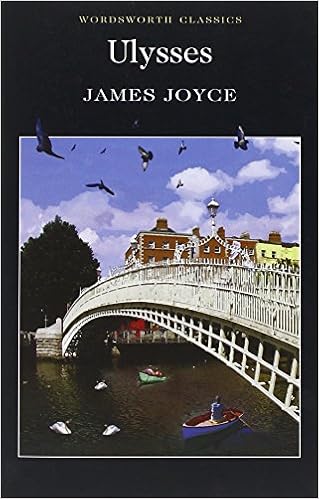
Ulysses ~ James Joyce

Words cannot explain how much I loved this amazing piece of work by Joyce!  I was astounded and flabbergasted by his knowledge and use of language. 

The structure of Ulysses is based on Homer’s The Odyssey, which I did read first, however without my study guide I would have missed an awful lot of the references, some of which were so clever that they were hilarious.  It is definitely beneficial to read The Odyssey first to fully appreciate the skill involved in creating the structure for Ulysses.

It is also beneficial to read A Portrait of The Artist as a Young Man to understand the character of Stephen Dedalus.  This I also did, and loved it, although it was heartbreaking in places.

Ulysses is set in Dublin and is basically one day in the life of Leopold Bloom, an Irish Jew (this in itself has many connotations which I won’t go into as the Study Guides describe it so much better than I).  Bloom is a bit of a loner, he’s on the outside of his group of friends, and he’s a cuckold.  He is however a very caring and gentle man, who dearly misses his son Rudy who died in infancy.  During the course of the day he finds himself concerned about Stephen Dedalus and tries to be a father figure to him, and after a challenging evening keeps him out of trouble.

Molly Bloom is Leopold’s voluptuous operatic wife, who is having an affair with the director of her theatre group.  The affair is no secret, and on the day that she is expecting her lover Leopold ensures that he fills his day and evening away from home. 

The events are mundane in themselves, a funeral, a visit to the newspaper office, a trip to the pub, a walk on the beach (where Leopold undertakes a lewd act), a visit to the ‘red light’ district (keeping an eye on Stephen) and eventually home again into the bed which is still warm from Molly’s antics.

The wonderful thing about this work is how it is presented.  First of all there are so many things that need to be kept track of (ie the lemon scented soap in Bloom’s trouser pocket which he buys in the morning, the outcome of the local horse race, and the various people he interacts with) as they crop up throughout the novel.  By various devices we learn about the history of Dublin and Ireland, its notorious figures (real and fictional) and politicians, along with the general mood of the day towards current events and Ireland’s stance with England.

The novel is written in many styles which, if read without a study guide, would be an impossible task to understand.  Once you realise what Joyce is trying to achieve within the style you marvel at his cleverness and revel in the words.  Such styles include one section which demonstrates the evolution of the English language from stylised Latin to Dublin slang.  Truly amazing! One part is written in the style of various prose such a newspaper accounts, diarists, sensationalist novelists, romantic novelists etc and another section is written like a play (the events in Night Town) etc. 

But, for me the most beautiful sections of Ulysses were those written as a stream of consciousness.  They were incredible, and made me think about the way that my own thought processes work and yes, like in the book, they do jump around and are unfinished. 

The last section is written as Molly’s stream of consciousness so that we finally get to see her point of view and why she is having an affair.  At first she seems to despise Leopold, but by the end you realise she does love him dearly and that realisation is the most beautifully written passage in the whole novel.

Ulysses is without doubt the most challenging book I’ve read since Thomas Pynchon’s Mason & Dixon.  It took me a good five months to complete with the assistance of a study guide, reading half an hour each morning before work when I could guarantee no interruptions and no danger of falling asleep which always happens when I read in bed! I finished it late last year but I have been ruminating on it ever since, still trying to get my head around what I have experienced, and I know that I will never read anything like it ever again.

Maxine

Thursday, February 4, 2016

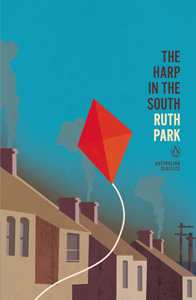
The Harp In The South ~ Ruth Park

Set in the slums of Surry Hills in Sydney, during the Depression, The Harp in the South follows the misfortunes of the Darcy’s, a working poor Irish Catholic family.  It doesn’t matter where it is set, as this story can relate to any family living below the breadline.  The daily struggles become the norm, and there’s plenty of families with a father like Hughie – easily led when it comes to the drink and a few pounds in his pocket, and a daughter like Roie (Rowena) - too innocent when it comes to the boys.

'Mumma’ Darcy battles daily to make ends meet.  Two growing daughters, a husband who’s generally M.I.A. at the pub on pay day, an elderly mother, two eccentric tenants (not forgetting to mention Puffing Billy the temperamental coal stove), and all living in a rundown cramped terraced house among many other struggling families.

There is plenty of humour, but there’s horror too – the flushing out and killing of the bed bugs, a seedy abortion house, and the ever present memory of Thady, the six year old son who went missing whilst playing outside.  Mumma is constantly haunted by what could have happened to him, what he would look like growing up, and this comes to a head towards the end of the novel.

On top of everything else, there’s the sheer lack of privacy in the Darcy’s lives.  Everyone ends up knowing their business, and paper thin walls don’t help.  Mumma is constantly worried about what the neighbours will think, which clouds her judgement when Roie is assaulted and she stumbles upon Roie's terrible secret which must be kept from the neighbours at all costs.

Originally published in the Sydney Morning Herald (in twelve daily installments in 1947) The Harp in the South is the second part of Park's trilogy, though it was written first.  It is nostalgic in the telling, which at times tends to gloss over the sheer awfulness of the Darcy’s lives, but it also makes you realise that if you have your family around you then you can pretty much face anything.  

Although I did read Missus first, The Harp in the South can be read as a standalone novel – but as I want to know how it all ends up I am currently reading Poor Man’s Orange too.

The Harp in the South was our six monthly ‘buddy’ read discussed via Twitter for January. (Follow @CaffeineChapter, @johnson_mjj, @JudyAuthor, @TomJohnson_Art, @Italiankiwiblog if you would like to join us for our next 'buddy' read!).

Maxine

Friday, August 14, 2015

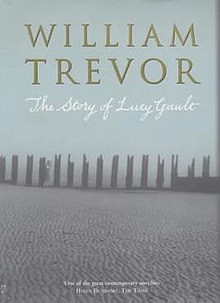
The Story of Lucy Gault ~ William Trevor

Set in Ireland, opening in 1921 during the Irish War of Independence, Captain Gault finds himself the target of arsonists who aim to set fire to the homes of protestant land owners. Trying to protect the house Gault lets off a gunshot which accidentally wounds one of the arsonists in the shoulder, a troubled boy known to Captain Gault.  Filled with remorse Gault visit’s the young man and his parents and offers them money.  It is incredible that he feels that he is the one who is in the wrong, but that is his perception.  The money is refused, and in fear of repercussions for his actions he decides to move his family (wife and daughter) to the safety of England.

The Captain’s daughter Lucy is distraught at the thought of leaving her beloved ‘Lahardane’, but she is only eight years old and doesn’t understand the trouble surrounding them.  No matter what she says, she cannot change her parent’s mind, so there is only one thing for it – she runs away. Lucy believes that once her parents find her they will understand just how much she doesn’t want to go and they will change their minds, however, Lucy injures herself and never makes her intended destination.  A search is made for Lucy once it is realised that she cannot be found in her usual haunts and, when clothing is found on the beach, it is supposed that she has gone for a swim and drowned.  Travel plans are delayed in the hope of finding a body, but eventually the grieving Captain and his wife leave, not for England as now that is not far away enough but for Europe with no forwarding address.

Henry and Bridget are two servants left to maintain the herd of cows and the grounds, and shortly after the Gault’s departure Henry finds a bundle of clothing – and within it a starving child close to death.  His life and that of his wife’s will change forever.

With no forwarding address the Captain cannot be contacted and although various relatives are tracked down, the fact that Lucy has been found goes no further than these relatives for various reasons.  

As Lucy grows up, her vigil for her parents remains unwavering.  She is convinced that they will eventually return, but as the months turn into years this vigil will have an unalterable impact on her life and happiness. 

I absolutely loved this, it is incredibly sad, but it is so beautifully written that you hardly notice how tragic it really is.  

Maxine

Monday, July 27, 2015

Musings on my Recent Book Choices

I was thinking today about how various books have become interrelated in my reading choices.  

A couple of years ago I was reading Maugham’s Of Human Bondage and by chance picked up another book where one of the characters was also reading Of Human Bondage (Dr Blood Money by Phillip K. Dick) and as he was actually reading out passages as part of his characterisation (being on radio in outer-space) I had to be careful of any plot spoilers!

Lately though it’s been Homer’s The Odyssey and James Joyce’s Ulysses that seem to have featured in my reading.  Many of the books I’ve read in the past few months have made reference to The Odyssey (such as The Untouchable by John Banville) and one of my latest reads Elizabeth Costello by J M Coetzee is referenced back to Ulysses with the title character having re-written Ulysses, from the perspective of Molly Bloom, with a book called The House on Eccles Street.  The constant reference to The House on Eccles Street had me intrigued so I thought I would check out Ulysses, and when I read that it was loosely based on The Odyssey my next reading schedule was set.  

The Odyssey didn’t give me the same challenge as my copy of Chapman’s translation of The Illiad did, but I can see how it would have entranced youngsters for many years.  It is more accessible and more of an adventure story.  However, it was important for me to read it if I wanted to understand the structure of Ulysses and I do like to do things right!

I started Ulysses as an audio book, but I soon realised that I wasn’t ‘taking in’ the stream of consciousness passages whilst listening to it in the car (driving being my main focus).  I bought the book instead and looked up Shmoop on-line who have a study guide for it and started again.  I love the myriad of thoughts that go through a character’s mind in just one passage alone and it has made me notice my own thought processes and how they jump around and cut off in the same manner. (Thought is the thought of thought). I can quite identify with Stephen Dedalus, though my thoughts aren’t quite as high ranging as his!

As it happened, around the same time, I started a new audio book in the car (Umbrella by Will Self) and I couldn’t believe it when the opening quotation was announced …….

“A brother is as easily forgotten as an Umbrella.” James Joyce

…… and the opening passage began with Zachary Busner, the main character, singing “I’m an ape man, I’m an ape-ape man” rather gleefully indicating that the narrative style is copying that of James Joyce’s, and boy did I enjoy it, it was so cleverly written.  The start of a sentence could be in one time frame with one character and by the end of the sentence you are in another time frame with a different character.  Quite often I didn’t even notice the shifts, and rather than being annoyed I enjoyed the challenge of going back and finding where it happened, thinking ‘you crafty bugger’.  I don’t think I would have enjoyed it half as much if I wasn’t doing Ulysses and was already ‘in the zone’ for that style of writing.

I’ll be with Ulysses for a while as I intend to take my time with it because it has had such a huge influence on literature and once I have read it I shall so enjoy those literary references that I could not have appreciated if I hadn’t done so.

Maxine

Wednesday, May 6, 2015

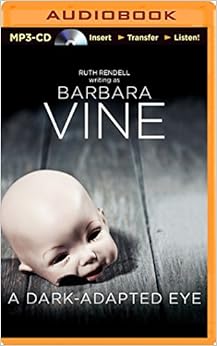
A Dark Adapted Eye ~ Barbara Vine

This month’s Caffeine and Chapters Book Club read is an Edgar Award Winning Novel.  Having never read any books from the list of winners I realised this was a genre I probably hadn’t tapped into.  I liked the sound of this title over all the others on the list and so I downloaded it as an audio book.

I didn’t realise that Barbara Vine was the nom de plume of Ruth Rendell’s.  I had recently read The Killing Doll by Rendell and thoroughly enjoyed her characterisations and the dark nature of the novel, so once I realised who had written this book I was quietly pleased about my choice.

What a great story it is.  It is the tale of a family with dark secrets and the secrets are slowly unraveled by Faith, the niece of the main character Vera, after she is approached by a true crime writer who wants to write about Vera’s life.  The title of the novel relates to the opening of Faith’s eyes to events in her family and seeing them with an adult’s new perspective.

The novel opens with Vera’s execution and Faith mentions just about all the main characters without us knowing who they are and how they will relate to the story.  As the novel progresses some of these characters and their relationships are a revelation.

In short Faith’s father has two sisters – Vera and Eden.  He places these two women on a pedestal as paragon’s of virtue and Faith finds it very hard to live up to their standards only to find that they were not very virtuous at all as she pieces together their past.  Vera is much older than Eden and pushes her son away in favour of raising Eden when their parents die.  Faith often stays with them on holidays only to find them whispering and keeping secrets and making her feel very uncomfortable a lot of the time.  Vera’s son is very scornful and cruel to her but Eden appears to counter his presence with beauty and a strong love for her sister Vera.

Things take a turn when Faith’s family are told that Vera is expecting.  She is a much older lady and with her husband away (this is set during the 2nd World War) they can do the math.  They don’t receive much communication whilst she is pregnant but are relieved when they are told eventually by Eden that she has delivered a healthy baby boy – Jamie.

Vera is completely devoted to Jamie, but when she falls very ill she is devastated by the fact that Eden has taken him to live with her and her new very wealthy husband.  Eden has been trying for a child of her own, but a miscarriage and subsequent problems mean that she can no longer have a baby.  What ensues is a very bitter custody battle to try and bring Jamie back home to Vera, which culminates in murder and Vera’s execution.

What I loved about this novel were the insights by Faith describing the time she spent with the two women.  What seems innocuous at first becomes darker when viewed in light of the later events.  The characterisations are absolutely brilliant and their history quite complex.  What we have here is a mystery story, but we are still left with a mystery at the end of it – well two actually.  Who was Jamie’s father and who is actually Jamie’s mother?

This is a fantastic read and Barbara Vine/Ruth Rendell will be on my reading list for the rest of this year.  With Rendell’s passing a few days ago I can see there are a lot of novels I need to catch up on.

Maxine


Monday, March 16, 2015

Strangers on a Train ~ Patricia Highsmith

Architect Guy Haines has the ability to achieve anything he wants in life – a successful career, a fantastic home, and a beautiful new wife……. but all this changes on the day he catches a train to Metcalf to talk to his estranged wife about a divorce.

On the train Haines is subjected to a very uncomfortable conversation with the wealthy but bored Charles Bruno, though when Haines reaches his destination he has pretty much dismissed Bruno as a harmless crackpot.  But Bruno sees this fortuitous meeting as the start of a very beautiful friendship ~ one that will come at great cost.

Bruno believes that he has the idea for a perfect crime, one that attaches no motive to the perpetrators, and which will secure each of their futures.  But Bruno’s careful planning doesn’t account for Haines having a conscience and the fact that there will be others who are determined to get to the truth.

Highsmith had me on tender hooks throughout this novel.  Her characterisations were excellent, I detested the smarmy alcoholic Charles Bruno and felt all of the emotions attributed to Haines.  The nightmare world that she portrays is unshakeable as is the persistent Bruno.  Living out his fantasies Bruno drags Guy, a once honest man, down into hell without the strength of character to make it back in one piece.

I did this one as a ‘buddy read’ with a couple of readers who I have connected with on Twitter.  All three of us felt the high anxiety of the storyline, and once we had finished we agreed that we needed something calming to read afterwards!

Hitchcock made a movie by the same name, but he detracted from the novel considerably and it is extremely dated by today’s standards.

Maxine


Friday, February 13, 2015

A Dark Love Letter to Iceland

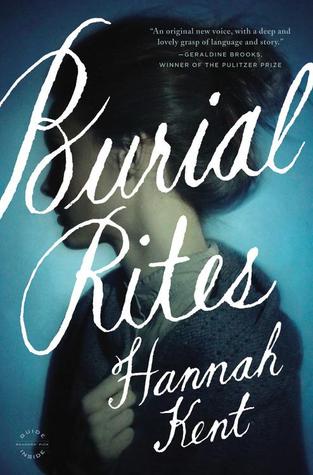
Hannah Kent intended her debut novel to be ‘a dark love letter to Iceland’ and I think she has succeeded.  I certainly feel a desire to visit this country with the beautiful place names and unforgiving landscapes after reading Burial Rites.

This is the story of Agnes Magnusdottir the last person to be executed in Iceland back in the 19th Century.  It is a story of abandonment, poverty, lust and murder.  The narrative has been based on extensive research by Hannah Kent and whilst there may be some invention/speculation as to Agnes Magnusdottir’s true personality, and her relationship with the compelling Natan Ketilsson, the story on the whole has been based on historical fact. 

There are several narrative voices which makes the story quite interesting.  I don’t always like this device but in this instance it works.  The story opens with Agnes in a very deprived state after her arrest and trial.  She is relocated to her home valley and housed with an unwilling farming family for the duration of the period leading up to her execution.  The family initially abhor this filthy criminal that has been brought to their croft, but as Agnes’s dignity begins to return they find themselves drawn to her and her impoverished history as she relates her story to a young priest who visits regularly to prepare Agnes for what is to come.  

I liked how Kent opened each chapter with an historical document relating to the case.  Ie how the axe was to be made, how much it was to cost, who they chose as executioner and why, and the specific preparations for the day of the execution.

This is not a happy story, but it is beautifully written.  I did it as a Bolinda audio book and the narrator was excellent.  Those Icelandic names just rolled off her tongue and I found myself repeating them because they are so gorgeous to pronounce.

After I read the book I went on the internet to find out more about Agnes Magnusdottir and whilst I mainly just found articles on Hannah Kent I did stumble across this blog post which I found interesting:


Maxine

Saturday, November 29, 2014

Ransom ~ David Malouf

Ransom is a beautifully written re-imagining of one of the stories from The Illiad.  

Patroclus is dead and the grieving Achilles, who has taken his revenge on Hector, is tormenting Hector's father King Priam by dragging the body behind his chariot around the walls of Troy.  Each night the gods restore Hector's body so that Achilles must repeat the process day after day.

There is no honour in what Achilles is doing, the body should and must be given up for decent burial rites but Achilles is in deep distress and feels that the gods are mocking him by restoring Hector's defiled flesh each night.

King Priam cannot stand to see his son so treated and decides to talk to Achilles face to face, man to man, and ransom Hector's body.  At first his advisors are against this, feeling that someone should go in his stead, but this is something Priam must do  himself, and not as a King but as a father.  He decides to remove all trappings of his wealth and wear just a white robe; a simple carter, his wagon, and his two donkeys are hired to carry Priam and his ransom to Achilles.

What happens on the way is no less a surprise to Priam than it is to Somax the carter, which gives him a story to tell his grandchildren and great grandchildren in the years to come after Priam has fallen at the hands of Achilles' son.

I absolutely loved this little novella. Having read The Illiad a couple of years ago, it was wonderful to find myself back in this classic story.

Maxine

Family Matters ~ Rohinton Mistry

When the elderly Nariman Vakeel breaks his ankle his world, and that of his immediate family, changes forever.

Set in Bombay, it appears Nariman is lucky for he lives in a spacious apartment with his adult step children Coomy and Jal, but after the accident Coomy struggles to deal with Nariman's daily toileting to the point she feels he cannot live there any more.  He is taken by ambulance to live with his biological daughter Roxana who lives in a two roomed flat with her husband and two young boys.  Already lacking adequate space the only place they can put 'Grandad' is on the living room couch.  The couch and the living room is Nariman's world for the next few weeks.

I absolutely loved this story, you are quickly drawn into the lives of this family.  The bitter Coomy, the hard of hearing Jal and the beautiful Roxana who must keep the family together despite the daily trials.  

I felt so many emotions whilst reading it - I felt absolute love for Roxana, the imposition put upon her by Coomy only makes her stronger.  She takes care of her father and all his needs without complaint.  I felt anxiety at her husband Yezad who makes some terrible decisions to improve their financial situation so that they can buy the necessary medicines for Nariman, who also suffers from Parkinson's.  I felt anger too at Yezad who will not stoop to help his father-in-law with his toilet requirements and will not allow his two sons to help either.

Nariman's story unfolds through torturous dreams and you feel sorrow for this man who was once a professor and who now suffers his illness and situation with the greatest of dignity.

This is a very thought provoking novel as there are many other secondary characters that are wonderful but tragic, like Mr Kapur the owner of the Sporting Goods Emporium where Yezad works. He loves Bombay as a woman, and hates to see her falling from grace beneath the corruption of those in power.  His strong opinions and Yezad's own deviation from the straight and narrow will be Mr Kapur's downfall.

This really is a wonderful read, and I felt sorry to say goodbye to Roxana and her beautiful boys on finishing the novel.

Maxine

Tuesday, August 26, 2014

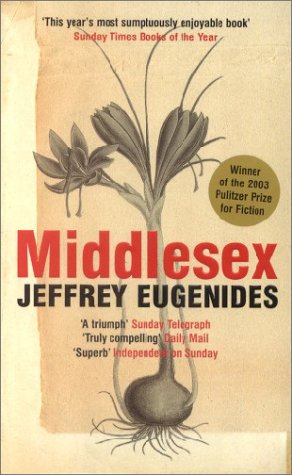
Middlesex ~ Jeffrey Eugenides

Not content with the emotional impact, nor the anatomical insight, contained in a diary written by an intersex convent girl in the 19th Century Jeffrey Eugenides decided to write a novel instead that would satisfy the reader's inquiring mind.

Middlesex is loosely based on the author's life and his own Greek heritage, however, Calliope/Cal (the protagonist) is his own creation and therefore the novel is not autobiographical.

I loved this book!!  Not only does it explore the themes of nature vs nurture, rebirth and the impact of a recessive gene on three generations of one family, but it also chronicles the life of two immigrant silkworm farmers from their isolated hillside home in Greece to their new life in prohibition era Detroit.

Calliope, their grand-daughter is born a hermaphrodite; however this is not discovered until she/he reaches puberty.  Told retrospectively, and commencing from the womb, Calliope takes us back to when her grandparents were young and how the recessive gene which is quite often found in isolated in-bred groups of people begins to rear its ugly head.

Really, this novel could have been distasteful however we are introduced to a wonderful group of characters with great personalities and eccentricities trying to make a success of their life in a new country, not knowing that their life choices are taking them down a road that will cause the teenage Calliope untold anguish.  Calliope suffers from the usual female teenage angst..... when will her period start?  Why is she so flat chested when her classmates are developing?  Why does she have a crush on her best friend?  Being of Greek heritage other tell tale signs are missed as she grows older .... the unwanted hair on her upper lip that needs waxing, the husky voice and the beginning of heavy set features.  I truly felt for Calliope as she brought back memories of my own insecurities as an introverted teenager.

One thing I didn't get was why Calliope's brother was called Chapter Eleven.  All the way through the novel I was hoping it would reveal itself.  It does actually, but very subtly and being Australian I didn't pick up on it.  American's would get it.  I won't spoil it here, read the book and if you are still in the dark you can Google Eugenides' answer.  It's quite clever.


Maxine

Friday, August 15, 2014

The House of Mirth ~ Edith Wharton

Whilst Jane Austen used her knowledge of drawing room conversions as inspiration for her novels, Edith Wharton has drawn upon her experiences as a member of New York’s Upper Class Society for her novel The House of Mirth.

This book was wonderfully written, with the conversations between each character feeling completely natural.  Wharton shows the fabulously wealthy as being conceited, shallow and condescending, where their only good advice is to make sure that you ‘marry money’, where ‘breaking in new people’ is tiresome and where the most laborious job of the year is going through your furs.

Lily Bart, the novel’s protagonist, is a popular and beautiful member of New York’s Upper Class Society around 1890.  She has no money of her own and her parents are deceased, but her Aunt takes her in and as she is very wealthy she makes sure that Lily has the best clothes to wear for any occasion. Lily’s mother and her Aunt have groomed her to be a beautiful ornament, but whose arm she is to hang off remains to be seen.  At 29 years old she is under pressure to marry, but she cannot make up her mind.  She loves Lawrence Selden but she would be stepping down in the world if she made that match, and he definitely could not afford her extravagances.  Percy Gryce is fabulously wealthy but he’s a mother’s boy and Lily’s smoking and mounting gambling debts scare him off.  Simon Rosedale, a Jewish suitor is distasteful to her, but he begins to be her only option as time goes on.

Whilst she ponders her future, Lily finds herself in more than one compromising situation; although totally innocent on her part they spark malicious gossip about her that will not go away.  When she is accused of trying to steal away the husband of one of her friends, Bertha Dorset, whilst holidaying on the Dorset’s yacht the scandal ruins Lily’s status.  Lilly is innocent of course, but Bertha is trying to deflect possible gossip about her own indiscretions with a poet.

As the rumours circle round Lily’s Aunt is appalled by her apparent behaviour and in the final weeks before her death she disinherits Lily leaving her only a small legacy which will just cover a debt which is hanging over Lily’s head like a black cloud. The payment of the legacy is withheld for almost a year until legal problems with the Will are ironed out, and Lily is forced to find work.  Having been groomed for nothing but ornamentation Lily’s work output is poor, she is let go and her health and state of mind begin to suffer.

No longer needing to aim so high for social standing, Lawrence Selden is once again a possible match, but fate will see to it that they can never be together.

What a tragic figure Lily Bart is, and this novel highlights once again how social conventions of the time make life extremely difficult for young single women.  Thomas Hardy shows us time and again with his novels, and now we see that it cannot be escaped even with the wealthy.

As for the title, it comes from Ecclesiastes 7:4: “The heart of the wise is in the house of mourning; but the heart of fools is in the house of mirth”.

A great read.

Maxine 

Wednesday, August 6, 2014

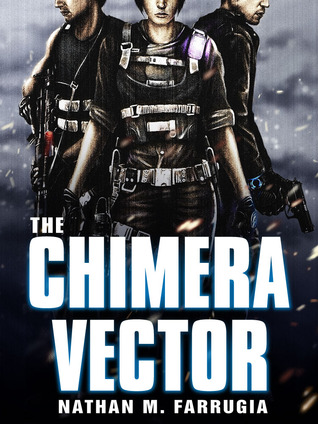
The Chimera Vector ~ Nathan M Farrugia

I was contacted by the author on Good Reads requesting a review in exchange for a free copy of this book.  I’d read a few Matt Reilly’s and this was touted as being a comparable novel.  To be fair, I haven’t read a Matt Reilly in a while and my tastes run towards 19th Century fiction these days, but I read the novel in its entirety and what follows in my honest review.

The Chimera Vector is a science fiction action novel which proposes that the economy and politics of the world are run by psychopaths (possibly a correct assumption) and a group of re-programmed Fifth Column operatives aim to break this stranglehold on humanity.

So far so good, but the story is much more complicated than this.  The theme is inspired by current events (being the ‘War on Terror’). The premise is that the war on terror is a façade manipulated by the secretive agency ‘The Fifth Column’.  I started writing down key points as they came up, but I must confess that the book lost me in the end.  Encryptions and viruses, counter encryptions and viruses, double agents, triple agents, quadruple agents …… an Axolotl vector which enables the carrier to heal like a Salamander and a bad guy who has found the fountain of youth……. I can only suspend my disbelief so far.  That is not to say that this book isn’t well written, it is, but I felt it tried to be too clever by half. 

It wasn’t as fast paced as a Reilly, and it wasn’t as much fun.  I didn’t care about the characters and ‘Damien’ and ‘Jay’ didn’t work for me as major character names.  It’s not until three quarters of the way through the novel that the pace actually picks up but I had trouble visualising the scenes and locations as there’s not much in the way of descriptive writing.

This is Book #1 of the Fifth Column series and will, however, probably gain a following from the target audience (which I believe would be young adult males who are into a bit of techno action) - it just wasn’t for me.

Maxine


Friday, August 1, 2014

Far From the Madding Crowd ~ Thomas Hardy

Bathsheba Everdene is a strong spirited girl, and whilst she thinks she knows her own mind she has not a clue with regards to the workings of a man’s mind.

Farmer Boldwood is a confirmed bachelor and even the beauty of Miss Everdene can’t turn his head at market. Bathsheba’s maid points out Boldwood’s indifference to her so, out of fun or maybe girlish spite, she sends him a Valentine Card sealed with a stamp marked ‘Marry Me’. 

This frivolous throw away moment changes everything. 

Boldwood becomes a man desperate to possess her, and presses her for her promise to marry to the point of breaking her spirit. Bathsheba had already turned down a proposal of marriage from the kindly Shepherd Oak when she first arrived in Weatherbury and Oak’s status looked like it was improving but, as her own situation improves by taking on her late Uncle’s farm, Bathsheba is in no hurry to lose her independence.  Unfortunately, during her unwanted courtship with Boldwood, she is dazzled by a rake (Sergeant Troy), who has already ruined one young woman, and the chance of future happiness begins to unravel for all.

Through this emotional drama Shepherd Oak remains a staunch and loyal friend, putting aside his own feelings to manage Bathsheba’s farm and trying to morally guide her.  In a time when propriety means everything, he has to withstand gossip from the neighbourhood which insinuates that he’s just hanging around Bathsheba and ‘biding his time’.

Set in Wessex, I loved the country setting and also the minor characters that work the farm.  Their dialogue and actions hark back to simpler times which consisted of manual labour, cider and gossip.

This novel highlights the fickleness of young women in matters of love. In an era when a promise is a promise, and solemnly binding, there’s no room for mistaken feelings. I’m not usually sentimental but Bathsheba’s realisation of Oak’s true friendship towards the end of the novel, and Oak’s realisation of his one dream, had me fighting back tears.

As for the title of the novel, it was taken from the following:

                      Far From the madding crowd's ignoble strife
                      Their sober wishes never learn'd to stray;
                      Along the cool sequester'd vale of life 
                     They kept the noiseless tenor of their way.
                                                        Elegy Written in a Country Churchyard by Thomas Gray

Throw away your bodice rippers, and read a love story with real class!

Maxine


Monday, July 7, 2014

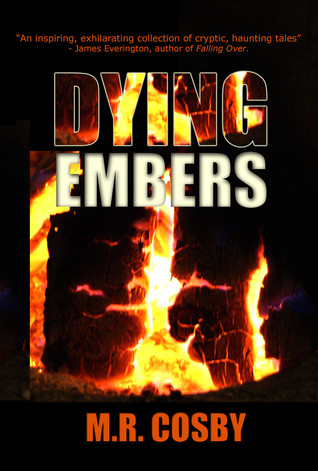
Dying Embers ~ M R Cosby

This is the first time that I have waited in anticipation for the release of a book by a home grown author. Knowing that the style was inspired by one of my favourite writers, Robert Aickman, I was very keen to read it.

Aickman has the ability to unsettle your nerves when writing about everyday events that at first appear normal then go slightly off kilter.  I can honestly say that I wasn’t disappointed. These short stories are very well constructed, and the unsettling nature of each varies in degrees as does the strangeness. 

Abraham’s Bosom was one of my favourite stories as it brought to mind how I felt on my recent visit to Rangitoto Island.  My partner and I had walked off the beaten track looking for lava caves and I became increasingly alarmed when I couldn't hear any of the other trekkers and was unable to orient myself to where we should be on our map.  This story of a jogger becoming separated from his running mate and experiencing a supernatural event reminded me not only of Robert Aickman but also of Alfred Noyes’ Midnight Express by the last passage.

Building Bridges I found to be a nice cloying story about a father wanting to reconnect with his family however forces move against him during a visit to a museum exhibit. 

The Next Terrace is the perfect opening story and lays the foundation to what can be expected within the following pages and Playing Tag I thought was a beautifully written story which really evoked the grounds of an English stately home.

La Tarasque was probably my least favourite of the collection but mainly because I couldn't identify with any part of it, and I’m still trying to work out the title of the last story (Fingerprinting) although I did really enjoy the story itself.  I’m staying in some obscure small towns at the end of the year on my first ever Aussie road trip, so I shall bear this story in mind!

This whole collection has been put together very nicely; Some of the stories are very subtle whilst others grab at you, but what I liked most about these stories is that they are very identifiable as being Australian (although you can’t take the P.O.M.E. out of the collection either – just like me!)

Maxine