Saturday, June 18, 2011

Good On Ya, Rosie

Now and again I seem to pick a common theme in my reading material.  This month it is evidently violence and animal abuse.  After some very disturbing scenes in The Wasp Factory I've had to endure some terrible scenes in Water for Elephants.  With this aside, it really is an engrossing novel.  Set during the Great Depression, it gives you an insight into how desperate men will do anything to remain in work even if it is with the unscrupulous Uncle Al,  the owner of The Benzini Brothers Most Spectacular Show on Earth.

There is a love interest, of course, and this is in the form of the talented Marlena whom Jacob, our narrator, is very attracted to.  Marlena is married to August the head animal trainer.  August is a paranoid schizophrenic and a very unlikable character indeed.  The novel is told by Jacob in the present remembering his life in the past, he is 90 or 93 - he's not too sure - and lives in a nursing home.  When a circus comes to town it triggers his memories.

Jacob has become a very cantankerous old man but he reminds you that we are all going to be old one day, that all old people were young once and, like Jacob maybe, they have a story to tell.

Ringling Brothers Circus is mentioned as the circus that Uncle Al aspires to become, and I was fascinated to note after Googling it, that it is a real circus that started in 1884.  It absorbed the famous Barnum and Bailey and was well known for its honest dealings, and is still in operation today.

And Rosie?  Well she's proof of the old adage that elephants never forget - and neither do they forgive.

Monday, June 13, 2011

Thoughts on The Wasp Factory

You do have to wonder how an author's mind works when you read something like The Wasp Factory.  It's a very twisted read indeed, not to mention violent.

Sixteen year old Frank Cauldhame is the narrator and he provides not only the horror but the humour too.  Frank's older half brother Eric has escaped from a mental asylum and he's on his way back to their isolated home in Scotland where Frank lives with his father.  We never meet Eric, but we do find out why his mind shattered, and we listen in on the bizarre phone calls he makes to Frank as he gets closer and closer to home.

Frank loves his older brother, but he is disturbed and horrified by the violent acts that he perpetrates on dogs yet Frank himself tortures animals and, during the course of the novel, he admits to murdering three children before he is nine years old.  Frank considers himself sane, and he has rational explanations for his murders, but he is aware that he needs to perform certain rituals - the sacrifice of mice, and the capture and killing of wasps in his 'factory' which he believes foretells the future.

In a way this character reminded me of Tom Ripley from The Talented Mr Ripley - Frank is a psychopath or a sadist but you actually quite like him.  I liked the way the novel unravels events from the past which have shaped Frank's present, and the revelation that even Frank is not what he seems. It's very well written, but it is very graphic and it would probably be wise not to read it if you are an animal lover.  I had to keep telling myself - it's only a story, it's only a story..........

It's been hard to find something interesting to read next, I'm trying Never Let Me Go by Kazuo Ishiguro but it's not really grabbing me.  I've read some really good reviews so hoping it picks up soon, and I'm listening to Water for Elephants by Sara Gruen.  I like the look of the movie trailer, but I always like to read the book first.  The narrators aren't bad, I think the old man is done very well, but the young man's voice is a trifle boring.  I don't know much about the story at all, but the premise is about a young vet student who joins a circus after his parents die in an accident and he finds that his inheritence belongs to the bank.  

Saturday, June 4, 2011

I'm Back!

Well actually, I have been back for the past week but I’ve been so busy catching up at work I can’t believe it’s already the weekend.  I didn’t read as much as planned, it was more tiring playing with a three year old than I expected and I was only interested in sleep by the time I went to bed!

The first thing I read when I got back was World War Z by Max Brooks.  I did start it before going to WA, but I started from the beginning again as I had really enjoyed what I read prior to leaving  and I wanted to ‘refresh’.  For a Zombie novel it was very intelligently written, fun and thought provoking.  It could have been a documentary on any war in history, the story is the same – the fight for survival and the inability of governments to act.

For book club our group read is The Light Keeper’s Wife by Karen Viggers.  I was hoping it would be better than it was. Set in Tasmania/Bruny Island it piqued my interest as I’m heading there over the Christmas break, but it was pretty awful.  It was morose and boring, and the character Tom (who I suppose Viggers was trying to write as a new age sensitive guy) was just wimpy and pathetic and more like a female character.

I’ve now started The Wasp Factory by Iain Banks, and although I'm only a few pages into it I really like it.  Frank, the narrator is a 17 year old boy but he’s really twisted.  His brother Eric also has problems and has been locked up in a mental institution from which he has escaped.  Frank reminds me a little of John Egan from M J  Hyland’s Carry Me Down but he is far more troubled and twisted.  I worried about John Egan, but I don’t think I’ll be worrying about Frank Cauldhame.

Wednesday, May 11, 2011

Thought's on Howard's End & Plague

Busy, busy reading as usual.  I have just finished Howard’s End by E M Forster.  It wasn’t quite what I expected as I was thinking it would be an Austen type love story, but I was way off the mark.

The story is mainly about the division of the British classes at the turn of the century, and it brought to mind a couple of other novels that I have read.  Margaret Schlegel the main protagonist reminded me very much of Dorothea Brooke from Eliot’s Middlemarch;  She is a strong minded woman in what appears to be at first an unsatisfactory marriage to the capitalist Henry Wilcox.  Both Henry and his eldest son Charles are good representations of those fickle selfish wealthy types that were portrayed in The Great Gatsby.

It took a while for me to get into the story, I felt at the beginning there was a lot of unnecessary back story to build up the plot, and although the tragic Leonard Bast was a main part of the plot I found his character to be the least well developed.

As well as focusing on the division between the social classes in 1910, it also looks at the generation gap which probably became more apparent with the advent of the motor car.  The younger generation would take to this over walking or taking a carriage.  When one of the Wilcox’s cars runs over a cat, Margaret makes an interesting observation that in their class the women hide behind their men and the men hide behind their servants for it is easier for them to send one of the servants with some cash to pacify the owner of the cat.

I did enjoy this novel but it just didn’t quite have the charm I was expecting.

My other read was Plague by Albert Camus, which I had really been looking forward to reading as I’d heard great things about other Camus works.  Whilst this was a good read, I didn’t feel that it was a great read, maybe I am missing something?  I was of the understanding that the narrative was in the same vein as Kafka, but I’ve read Kafka and I didn’t think this was the case.

The novel centres on Oran, a town in Algiers in the 1940s, and is a fictional account of a plague epidemic that strikes the population and results in the town being quarantined.  I liked the way that Camus built up the tension with the discovery of the dead rats, and the feeling that something wasn’t quite right.  As the plague sweeps through the population the town is isolated and then we follow the emotions of a group of men as they deal with separation from their loved ones, the desire to escape the town and their duty to help the afflicted. The graphic description of the final hours of a young boy will stay with me for a long time.  It was sheer suffering.  So, needless to say this is not a light read.

Well, I shall be off the ‘airwaves’ for the next couple of weeks as I’m heading West to spend some time with my family, and especially to meet my new grandson.  I do hope to get plenty of reading done however and have selected Never Let Me Go by Kazuo Ishiguro, The Lightkeeper’s Wife by Karen Viggers (Caffeine & Chapters Book Club group read), World War-Z by Max Brooks and The Wasp Factory by Iain Banks.

So, I’ll sign off for now and happy reading all J

Thursday, May 5, 2011

Just for the Record, The Weather Today is Frazzled

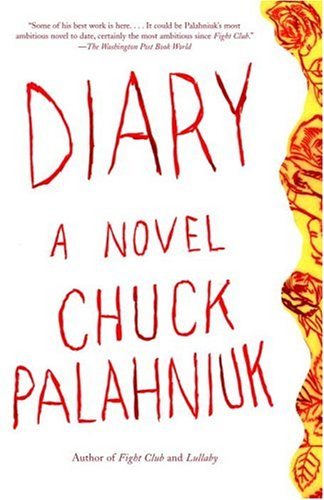
I have just finished listening to probably one of the wierdest books I've 'read' yet (not including that horrible Naked Lunch).  It was called Diary and was written by Chuck Palahniuk.  I read Choke a little while ago and really enjoyed it, but it certainly didn't prepare me for this dark little satire.


At first, I wasn't sure where it was going, and I went back to the beginning a couple of times.  This was an audio and I wasn't keen on the narrator (Martha Plimpton) so it didn't quite grab my attention until half way through the novel.  It's rather twisted and disturbing with plenty of clues throughout to give you an idea where the plot is heading, but I didn't really pick up on many of them until nearly the end!

Basically it's about an island legend that is re-enacted every third generation.  It's a story about re-incarnation, torture and ritual sacrifice, and should really be my cup of tea but I didn't like the way it was written.  Misty, the protagonist, writes the novel as a diary.  It's a 'coma diary'. Misty's husband is in the hospital in a coma after what appears to be a failed suicide attempt. Misty's mother-in-law encourages her to keep a diary so that when he awakes he can catch up on the time that he has missed.  But it doesn't really read like a diary, and Misty calls herself Misty and her husband Peter 'Peter' with the occasional  reference of being 'your wife' or 'you' which kind of brings you back to the fact that it is a diary.  There is another diary is the story which is owned by Misty's mother-inlaw who claims to know what Misty is thinking or how she is feeling because it is in the diary.  The reason for this becomes apparent towards the end of the novel. 

As in Choke, there was a repeated phrase throughout.  This one being 'Just for the record' or 'Just for the record the weather today is.......' with the weather being Misty's current mood.  It was quite a claustrophobic novel, and the vibe was very much The Stepford Wives.  I think that if I had read the actual book instead of listening to it I may have enjoyed it more than I did.

My next read?  Something light and turn of the century is beckoning - Howard's End by E M Forster :)

Monday, April 25, 2011

A Gripe

Well, I finished The Last Block in Harlem and I really didn't like the ending.  In fact from about halfway in it got a bit bizarre actually and I don't like that when I'm reading.  Keep it real from start to end, or if you want to throw in the magic realism or surrealism you have to do it from the start.  I'm not a fan of changing the rules halfway through.

I stuck with it though as the way it was written was okay, and I did want to keep going to see where it's was going to end up; but (for me) the ending was way off the mark.  In fact as I was reading it I was thinking, hang on, this is Odd Thomas, what's going on?  I gave it a three star review mainly because there was more to this book than just reading it, and it was fun being part of it.  However, I'm really pleased I didn't do it as a book club read, as I think my members would not have liked it at all. 

There were a few editing errors in it, though not as many as in Opposing Energies, and I wonder why, when you go to the trouble to get something published and it is proof read and edited and all the rest of it, how does the finished product still contain so many errors?  I paid for both OE and LBH and as such I want to be receiving the polished product; Opposing Energies has so many errors that I can only bear to read a few pages at a sitting.  I think now, after giving independent authors a go, that I will stick to my reading lists and the tried and true.  OK, even they may contain the odd error, but they're definitely worth reading too.  I'm not rubbishing the two novels above at all, Opposing Energies just isn't to my taste and personally I think that it would work better as a graphic novel and I do feel that there is some value to reading The Last Block in Harlem just in the way that it has got me thinking about myself and about how and where I live.

My next read will be Plague by Albert Camus and my next audio will be Diary by Chuck Palahniuk.  Both should satisfy my horror or blood lust. Talking of horrors, I can't believe the junk I've been renting on DVD this week in the name of horror.  What is going on?  The cover to The Last Exorcism didn't even relate to anything in the movie, and again this is an example of something losing its way halfway through.  It was dumb, but the thing is most of the viewers aren't.  Give us something decent, if you call it horror - then horrify us.  Is it that hard?  Actually the most frightening thing I've seen all week was an armpit on Embarrassing Bodies that had me screaming, gagging and covering my eyes.  So it can be done!  I also rented Monsters and whilst it wasn't terribly scary, the acting wasn't bad, and the sets were really good.  The monsters were even cute in their own way, so I guess I kind of liked it.  Devil wasn't bad, I was wanting a nasty little ending, but it had a very moralistic ending but still, it worked.  Tonight I'm going to try Let Me In.  They reckon it's the best American Horror Movie in 20 Years - you'll be hearing from me if I disagree!!  In fact the most horrifying thing about my DVD rentals this week was the little surprise I found behind one of the cases:


Friday, April 22, 2011

Thoughts on The Last Block in Harlem

I'm now halfway through this book, (it's not very long but I'm reading a few other novels too so I'm just slotting it in for fifteen minutes in bed before I put the light out).  It's been a sort of 'pick me up' after Suzuki's Spiral which was really dreadful!  LBH in comparison is a very pleasant read.

The premise is certainly original, so full marks there.  The only problem I'm finding with it is that I'm used to reading long rambling novels where you really get into a characters head.  I'm feeling disappointed that the characters I'm meeting here are fleeting.  They're certainly individual and interesting, but I want to know more about what makes them 'tick'.  It's all too condensed, though this is the author's intention, he say's "...the characters move in and out like a New York subway ride".  

Everybody has a story to tell and it's actually got me thinking about  my own neighbourhood.  Living in a leafy suburb in Queensland, surrounded by wildlife, I barely even see my neighbours let alone getting to know them.  I wonder what their stories are?  I can't begin to imagine the high density living described in LBH, you wouldn't have much in the way of privacy.  I don't think I could live like that, or if I did I would soon be known as a recluse or 'the crazy cat lady'!  However, the message I'm getting as I'm reading is that it doesn't matter where you live, it's the sense of belonging and the pride that you take in your neighbourhood that is important.

So, summarising what I have read so far, it doesn't rank up there with great literature, but it is very real in it's message and it's got me thinking a lot about myself and the people around me, which is a really good thing.

Herz is a very approachable author, and has made the reading of his novel fun with the way that he has gone about its marketing and promotion.  You feel part of a community that is reading The Last Block in Harlem. He is also the creator of the wonderful Sunday Morning Story http://herzwords.wordpress.com/.  It is visual and poetic and reminds us just how special being alive is and how we should not waste time worrying about the small stuff.  We need to get some of the 'powers that be' to take the time to realise this too.